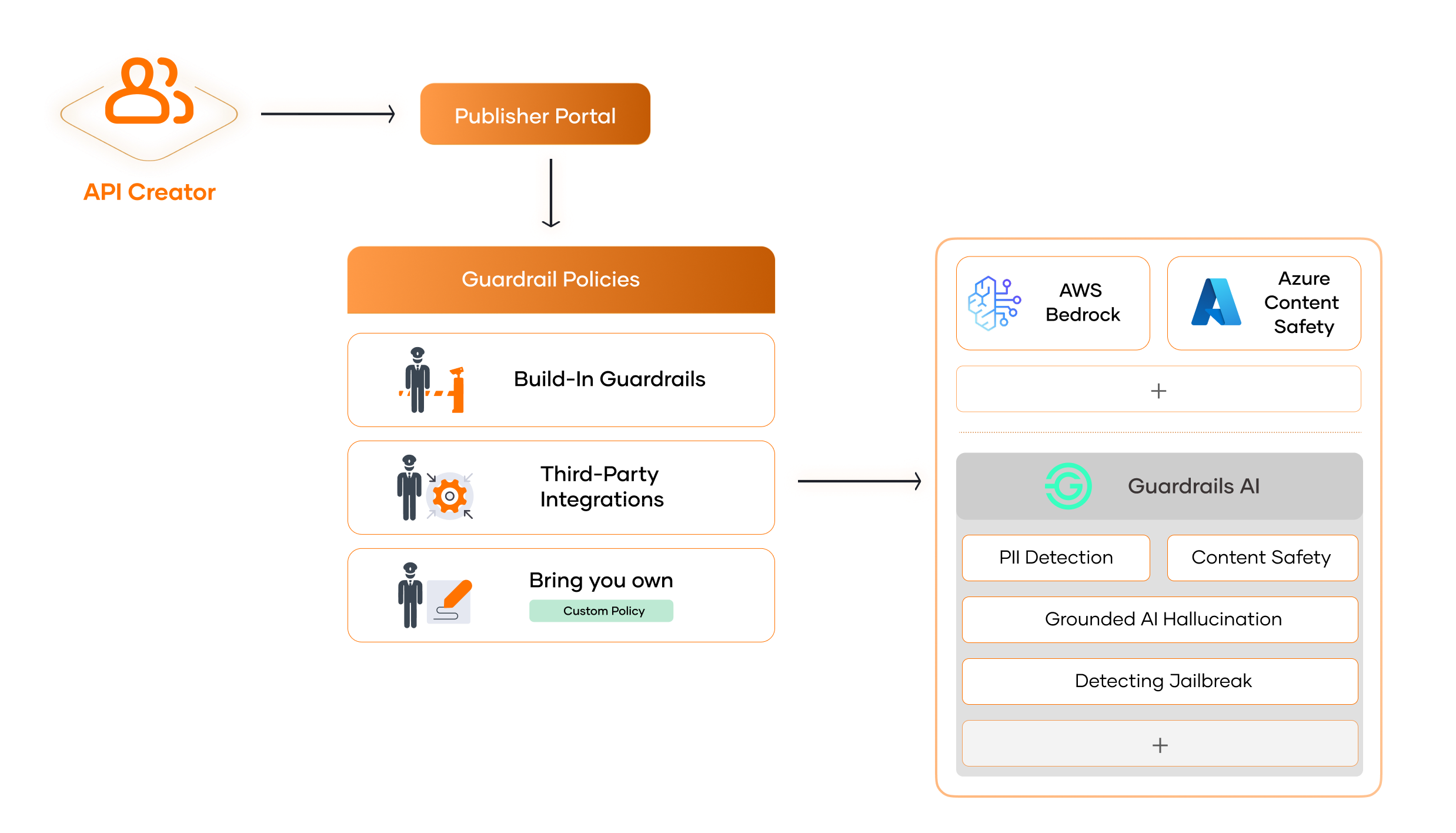
AI Guardrails
Generative AI brings immense potential—but without the right controls, it also introduces significant risks.
LLMs (Large Language Models) are fundamentally non-deterministic. A request may succeed technically (returning a 200 OK), but semantically fail your application’s logic, output expectations, safety guidelines, or compliance mandates. This disconnect creates a growing need for real-time enforcement of AI behavior.
What Can Go Wrong: Risks of AI API Integration
| Problem | Description |
|---|---|
| Unpredictable Outputs | LLMs may generate factually incorrect, incoherent, or harmful content even when inputs seem safe. |
| Bias and Fairness | AI systems can amplify biases from training data, leading to discriminatory or offensive results. |
| Security Vulnerabilities | Attacks like prompt injection can subvert your prompts and redirect model behavior maliciously. |
| Privacy Leaks | Generated outputs can expose sensitive or personally identifiable information (PII) unintentionally. |
| Regulatory Risk | Lack of content moderation or auditability can breach compliance frameworks such as GDPR, HIPAA, or internal ethical standards. |
As adoption of LLMs and AI services accelerates across sectors, it’s critical for organizations to move beyond experimentation and toward safe, reliable production usage. This requires governing AI systems a through a structured behavioral control framework that ensure:
- AI outputs remain aligned with organizational values, policies, and formatting standards.
- Requests are inspected and validated before reaching the model to prevent abuse or misuse.
- Responses are evaluated and refined to uphold quality, safety, and compliance.
- Systems can respond intelligently through retries, fallbacks, or logging when model behavior deviates from expected norms.
These practices help establish trustworthy AI integrations, minimize unexpected failures, and enable organizations to confidently scale their AI workloads in production.
Safeguard AI API Integrations with WSO2 AI Guardrails
AI Guardrails in WSO2 AI Gateway are real-time validation and enforcement layers that sit between your application and the underlying AI provider.
They act as intelligent filters that:
- Inspect both inputs and outputs to AI models.
- Apply policy-driven checks to assess safety, quality, and compliance.
- Enable client applications to implement adaptive response strategies based on given guardrail error responses.